Write Dead Cat ILWs (a year later)

It’s a crazy time of year for us reinsurance brokers. The days just before 1/1 feature little ‘work’ in terms of hours spent making stuff like submissions, analyses, meeting schedules, etc. They do feature, however, a load of stress as the negotiations for deals incepting at 1/1 reach their fever pitch.

Anyway, in my spare moments this week I’ve sought refuge from the casualty market and swapped my actuary hat for my catastrophe analyst hat.

I have an ongoing fascination with inflation rates. I’m not entirely sure what they are, but wow do they sure exist. Have a look a these figures (swiped from Swiss Re’s sigma reports) on catastrophes deflated to their original nominal values by the CPI, which Swiss Re uses to trend their losses to present day dollars. I’m going to argue this is a stupid idea.

There are two trend lines below.
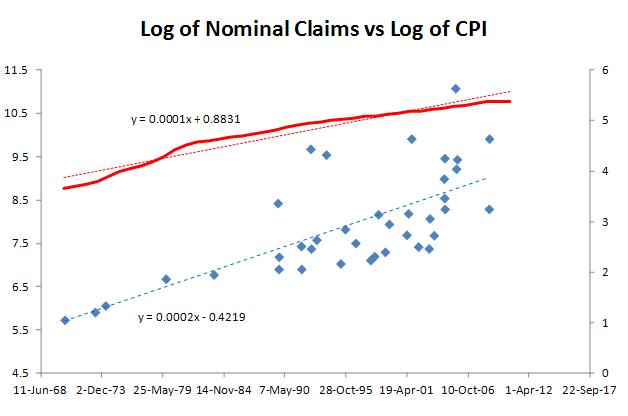
One, the red, is a linear fit of the ln of the CPI level. (Always use the log of a growth rate to pull out the compounding effect*)

The other line is my nominal catastrophe cost data. Notice that the slope is about double that of the CPI. Obviously some of that is due to the fact that there are WAY more outliers.

Remove those (arbitrarily), though, and some effect remains.

The CPI is a funny thing – a strange mixed bag of goods and services. Occasionally I dig into the CPI and one day I hope to to see if I can figure out what a good basket that predicts these cat cost levels might be.

I’m missing Non-US data, of which there is some in the source files I used. I kicked what was there out because they’re presented in USD each year (at that year’s FX rate) and inflated using the US CPI. Blagh. PPP is weak weak weak and even in theory only applies to general monetary inflation, which is completely different to building cost inflation plus the hundred other possible non-monetary sources of claims inflation for catastrophes+.

Ok, the next bit of analaysis, which is what I really wanted to do. Here’s the question: how good are the estimates of the total cost of these disasters at year-end following the loss? Here’s the answer: pretty good.

Each year, Swiss Re report the Industry loss size and, amazingly, the nominal values rarely fluctuate.

There are two notable exceptions. First is Katrina, which jumps big-time, from 45bn to 65bn. The reason for this is that Swiss started including flood losses in this total only a year later. The second exception is Wilma, which was notorious at the time for being an under-reserved loss. We were down to the ‘W’ in the hurricane alphabet and some suspect that insurers were being willfully blind to preserve capital/face so they could better handle Katrina.

These estiamtes are used heavily in a market for products called ILWs (Industry Loss Warranties). These work like this: pick a level (say 20bn US Wind) and collect if the industry payout exceeds that amount. Lower attachments (10b, 5b, etc) means higher probability of loss and so a higher price.

What’s more is that there’s a market for covers called ‘dead cats’, which supply coverage for a catastrophe after it happens. For example, when Hurricane Katrina hit, the loss first loss estimates were something like 20bn (this being a week after the loss). A prudent insurance company might look at that loss and say, wow, I think it’s going to be much higher than that. They then go to the market and buy cover agains the deterioration of the loss estimates of a catastrophe that’s already happened (a ‘dead catastrophe’ or dead cat).

This analysis suggests dead cats are a great write. A year out, anyway.

* A few weeks ago, my mom said the following to me (paraphrased): “I remember so little about high school math. I learned what I needed to to get through it and into a good University, but who really cares? Like, does ANYBODY actually USE logarithms?”

+ For example, catastrophe models use one proxy called ‘demand surge’, which purports to measure the non-linear increase in costs for rebuilding things when the normal supply of local materials/labor is fully occupied. Economies can only be stretched so far. Remember people traveling from all over the country to New Orleans to build houses after Katrina? Well, the housing supplies market before all that supply showed up is what demand surge measures.

Google and The Tragedy of the Commons

This caught my eye:

There are a lot of things I love about my Android phone–like the easy integration into the rest of my Google life. With the release of iCloud, that’s less of an advantage now than it used to be. Sure, some of the Android devices are beautiful, but if they become obsolete in a year from a software perspective in less than a year, this is going to be a serious problem.

There is a linked-to commentary of an original editorial, which is all a very interesting discussion.

The problem is a cultural one: Samsung considers its relationship with the consumer to be concluded the moment the sale is completed. Whereas Apple, Microsoft, and other software vendors have learned the value of supporting current users in the hope of enticing new ones, Samsung’s attitude remains deeply rooted in its history as a hardware manufacturer. It sees production and R&D costs in one column and it tries to balance them against sales revenue in the other, never raising its gaze to the long-term consideration of whether anyone would come back for a repeat purchase.

And from the commentary:

Samsung, as with HTC and — until a few months ago — Motorola, is a primarily a hardware company. They only make a buck when that device is purchased by a carrier or individual. Thereafter, every ounce of effort it puts into producing an update for devices already on the market eats into its profit on that sale.

Compare this to what Amazon chose to do when it forked Android for the Kindle Fire. Now, for all intents and purposes, it owns its own version of Android. It, unlike all of these companies making phone after phone using Google’s Android (plus a crappy skin), is in control of its platform and has incentive to improve and update it.

The problem isn’t Samsung, it’s systemic to Android as a whole. The makers of Android hardware see little benefit in updating even devices that are less than a year old. And, though I think it’s a punk move, I don’t blame them. There is little to no return to be had.

This is a classic tragedy of the commons. Google has this strange strategy of providing a lot of the public goods for the Internet and now maybe they’ll find that this is too big of a burden to bear?

Or maybe they go full government and raise taxes (license fees). No doubt they’re measuring the impact of mobile advertising on the bottom line. Maybe Google’s worst case scenario is Apple finding a way of sucking all that traffic into its ecosystem (a la AOL from the 90s). So keeping Android healthy and free keeps the Internet free and ad-driven.

Review of Review of 21 Books on the Financial Crisis

I had a 7 hour drive today back to the city so I was ready for the podcast firehose. I read about this paper this morning and experimented with some text-to-speech software and managed to listen to the whole paper in the car. Fun!

Anyway, I was hoping for more of an upshot than this:

There are several observations to be made from the number and variety of narratives that the authors in this review have proffered. The most obvious is that there is still significant disagreement as to what the underlying causes of the crisis were, and even less agreement as to what to do about it. But what may be more disconcerting for most economists is the fact that we can’t even agree on all the facts. Did CEOs take too much risk, or were they acting as they were incentivized to act? Was there too much leverage in the system? Did regulators do their jobs or was forbearance a significant factor? Was the Fed’s low interest-rate policy responsible for the housing bubble, or did other factors cause housing prices to skyrocket? Was liquidity the issue with respect to the run on the repo market, or was it more of a solvency issue among a handful of “problem” banks?

Apparently we still don’t know what the problem was, though leverage, regulatory capture/incompetence and ‘global imbalances’ show up a lot. Screaming for some mention is my favorite explanation, which is a Cowen-Sumner synthesis: we weren’t as rich as we thought we were and that realization was more painful than it should have been because the fed screwed up and continues to screw up. The rest is a bunch of banks that should have gone bust.

Lo goes on to finish the paper with a discussion of how economics is basically an irretrievably inexact science (ie we may never Know The Answer) and then, oddly, goes on to do a bit of primary journalistic research, suggesting some rule change by the SEC didn’t actually open the gate for increased leverage in 2004, contrary to many claims.

The real take-away for me is that the best academic and journalist books, respectively, on the crisis are “This Time It’s Different” and “Too Big to Fail“. I’ve read the second and will some day read the first, I think.

I’ve had just about enough financial crisis porn for a little while, though.

Lessons in Pitching

How Fab.com got its backing:

From a fundraising standpoint, providing access to the RJ data basically said to the VC’s, “here we are, here’s the data, we’ve got nothing to hide, take a look and decide for yourself if you want to pursue investing in Fab.” Effectively, we turned the pitching on its head. Since the RJ data updates several times per day directly from our database, it was many times more powerful than providing powerpoints and excel spreadsheets. This was the real stuff, auto-updating! And, since RJ enables all the data to be downloaded into excel, the analysts at the VC firms were able to do all of their own analysis on the front end of the investment process.

Now I’ll break away from this to describe what I do for a living: I raise capital for insurance companies.

Insurance companies typically aren’t financially strong enough to absorb the risks associated with the policies they write. Every year, then, they renew reinsurance arrangements with third party companies that give them a boost. This process has all kinds of effects:

  • In a fantastically capital-intensive business, scaling up becomes relatively trivial, if you can demonstrate that you’ll make money doing it.
  • The plain fact that reinsurers ‘give the pen’ to companies that can bind them to financial obligations without itemized signoff means the scrutiny during the renewal process is often intense. This acts as a powerful mechanism for dispensing best practices throughout the industry
  • Bringing several capital backers up to speed on what you’re doing consumes valuable management time. Every year.

This last point is where brokers come in: we’re middlemen that facilitate this process by being a negotiation agent, knowing the market and performing some common data-crunching and cleaning tasks.

Each of these tasks are things that could be done without us. We’re middlemen, after all, as derided a professional class as there has ever been. But in every deal we minimize a big risk of failure.

Negotiation is tough and can break down easily and data cleaning is a pain; most importantly, though, even a small market like mine changes ALL the time and by acting as a clearinghouse for relationships, we facilitate a more competitive reinsurance market (ie maximize terms for our clients in a macro-sense, as well as by being individually awesome).

So let’s go back to Fab.com. They sent out the data and had a quick negotiation in which, they claim, price wasn’t much discussed. Wow, wouldn’t you want to be Andreessen Horowitz in this case? Name your price!

Maybe Fab.com have such a powerful business model that they only need to show some trend numbers and have a quick chat and wrap up 50 million bucks. But as much as it warms an engineer’s cockles to hear a story where a great data system wins the day, all of my instincts tell me that these guys got screwed.

If a deal goes down with so little pain somebody left money on the table.
——
Update:

I just read this by Mark Suster which gives me a clue for why there might be a bigger pie at stake than I thought:

And anybody who follows this blog knows that I believe television disruption has already begun and it is more likely to resemble Internet content than streaming long-form content to our living rooms.

As I talked about this model with several friends in Silicon Valley I always heard the same refrain, “we don’t invest in content business – they are ‘hits driven’.”

I had to laugh a bit at at the irony of this. For one, the consumer-driven startup world has become immensely hits driven. You need star power of entrepreneurs surrounded by star power angels & VCs who in turn get tons of press from adoring journalists who are insiders amongst this crowd of tech cognoscenti.

Publicity! Big-time VCs are tech celebrities, of course, and affiliation with them can legitimize you in some important circles like with early adopters, journalists and investment bankers who will one day give you your big money exit.

Still, I need to swap my “let’s build a business!” hat for my cynic hat to have this make sense.

Then again, maybe legit publicity is actually so value-creating that it’s worth 10-30% of the upside.

Everything You Need to Know About Fiscal Policy

1. Its benefits are probably ambiguous. For every paper that says it’s good, there are some that say it is not.

2. The most powerful argument against fiscal policy has nothing to do with whether it works or not, actually. And Krugman knows it:

there is now overwhelming evidence that fiscal policy does in fact work when it’s not offset by monetary policy

Scott Sumner would say that Japan is all the evidence you need to know that the monetary authority will work to neutralize fiscal stimulus no matter what happens. It’s because ALL stimulus also raises inflation.

If people are freaked out by inflation via central bank monetary policy, they’re freaked out even more when it comes via big government. And the central bank is not interested in freaking anyone out.

Review of David Merkel’s Analysis of ROE During the GFC

Link here.

Abstract:

From 2005-2010, the change in public company returns on book equity [ROE] was wrenching during the financial crisis. The results were uneven by sectors, and even by geography, for stocks traded in US equity markets. This paper looks at the differences, and attempts to explain why there was so much variation by sector and geography. After that, the paper attempts to explain the correlation between changes in ROE and stock returns, by year, sector, and geography.

In a world in which I didn’t have only 20 minutes to read, analyze and write about this paper, I’d like to think through his model choices. I would feel much more comfortable on this point if he accepted the Russ Roberts Science challenge and have a section discussing the process by which he arrived at the process by which he arrived at his conclusions.

Aaaanyway, the paper is interesting in that it identifies some interesting countries (Mexico? Israel?) that had companies that did very well during the crisis. Another interesting thing is that he decomposes the performance of individual US States but immediately discounts the conclusion by saying that the location of these corporates are due to historical accident:

To some degree, historical accidents help explain why some states have high contributions to returns on equity, and others low contributions. Washington State has Microsoft, Amazon, and Costco, all of which started out there. Michigan has General Motors, Ford, and Chrysler; the automobile industry has long been a big part of the state economy.

The contribution to ROE of Arkansas can be entirely attributed to Wal-Mart. Washington, DC can largely be attributed to Danaher, though Fannie Mae pulled the contribution to ROE down considerably as it failed in 2008.

The results of Kansas are dominated by Sprint Nextel, which has been a weak competitor in wireless telephony, though YRC Worldwide also had some impact on the low contribution to ROE as it was too acquisitive heading into a major recession. Virginia has many strong companies, but Freddie Mac pulled the contribution to ROE down with it failure in 2008.

Companies don’t move often, so attributing the differing contributions to ROE to state policies is unlikely. In the extreme cases listed above, all of the companies listed had been headquartered in their respective states for a long time, and most had been started there

I’d have two comments:

1. What’s the point of decomposing them, then?

2. Can’t you just attribute ALL variance of corporates to ‘historical accident’? Can there be no policy implications?

On point #2, I’d defend Merkel by saying that policy implications need a big enough sample that you can reasonably hold other factors constant. You’d need a dataset of every industry in every state over every conceivable macro-economic environment, then control for those other factors. Same applies for analyzing different countries.

But, you might say, every industry isn’t in every state! Yep, that’s why this kind of analysis is probably better classified as ‘interesting’ than ‘science’.

He probably should have left the geographical component out if he (rightly) concluded that there aren’t any policy implications. Or at least chose a different basis than political geography: how about companies on coasts vs inland? High vs low altitudes? Near vs far geographically from ‘bad’ industries (like financial services)?

Anyway, none of the criticism is a knock on Merkel who is a first class analyst with a first class blog.

Wisdom of Tyler Cowen [enough to be dangerous?]

From his talk on stories:

The link and pointer come from Ben Casnocha, here is one excerpt (emphasis is from Ben):

…as a general rule, we’re too inclined to tell the good vs. evil story. As a simple rule of thumb, just imagine every time you’re telling a good vs. evil story, you’re basically lowering your IQ by ten points or more. If you just adopt that as a kind of inner mental habit, it’s, in my view, one way to get a lot smarter pretty quickly. You don’t have to read any books. Just imagine yourself pressing a button every time you tell the good vs. evil story, and by pressing that button you’re lowering your IQ by ten points or more.

One interesting thing about cognitive biases – they’re the subject of so many books these days. There’s the Nudge book, the Sway book, the Blink book, like the one-title book, all about the ways in which we screw up. And there are so many ways, but what I find interesting is that none of these books identify what, to me, is the single, central, most important way we screw up, and that is, we tell ourselves too many stories, or we are too easily seduced by stories. And why don’t these books tell us that? It’s because the books themselves are all about stories. The more of these books you read, you’re learning about some of your biases, but you’re making some of your other biases essentially worse. So the books themselves are part of your cognitive bias. Often, people buy them as a kind of talisman, like “I bought this book. I won’t be Predictably Irrational.” It’s like people want to hear the worst, so psychologically, they can prepare for it or defend against it. It’s why there’s such a market for pessimism. But to think that buying the book gets you somewhere, that’s maybe the bigger fallacy. It’s just like the evidence that shows the most dangerous people are those that have been taught some financial literacy. They’re the ones who go out and make the worst mistakes. It’s the people that realize, “I don’t know anything at all,” that end up doing pretty well.

The talk itself is here on video.

Higgs and Stats

Every time there is some science news, I always hold my breath until SWAB comments. And on this issue Ethan Siegel does not disappoint. I highly recommend reading him if you’re interested in great science writing.

Anyway, I’ve been pretty confused about a lot of the statistics around the evidence of the Higgs Boson. I’ll set this up, first, though. Here’s Ethan:


Back in 1976, there were only four quarks that had been discovered, but suspicions were incredibly strong that there were actually six. (There are, in fact, six.) If you look at the above graph, the dotted line represents the expected background, while the solid line represents the signal published here from a E288 Collaboration’s famous Fermilab experiment. Looking at it, you would very likely suspect that you’re seeing a new particle right at that 6.0 GeV peak, where there ought to be no background. Statistically, you can analyze the data yourself and find that you’d be 98% likely to have found a new particle, rather than have a fluke. In fact, the particle was named (the Upsilon), but when they looked to confirm its existence… nothing!

In other words, it was a statistical fluke, now known as the Oops-Leon (after Leon Lederman, one of the collaboration’s leaders). The real Upsilon was found the next year, and you shouldn’t feel too bad for Leon; he was awarded the Nobel Prize in 1988.

But the lesson was learned. It takes a 99.99995% certainty in order to call something a discovery these days.

6 sigmas?! WTF?! That’s humongous. That says to me that they’re either using the wrong distribution or the number of observations is immensely higher than any dataset I’ve ever seen. Considering these are probably the most competent statisticians on earth, I have to assume the latter, but… seriously?! SIX standard deviations?

I’d love to see the data.